
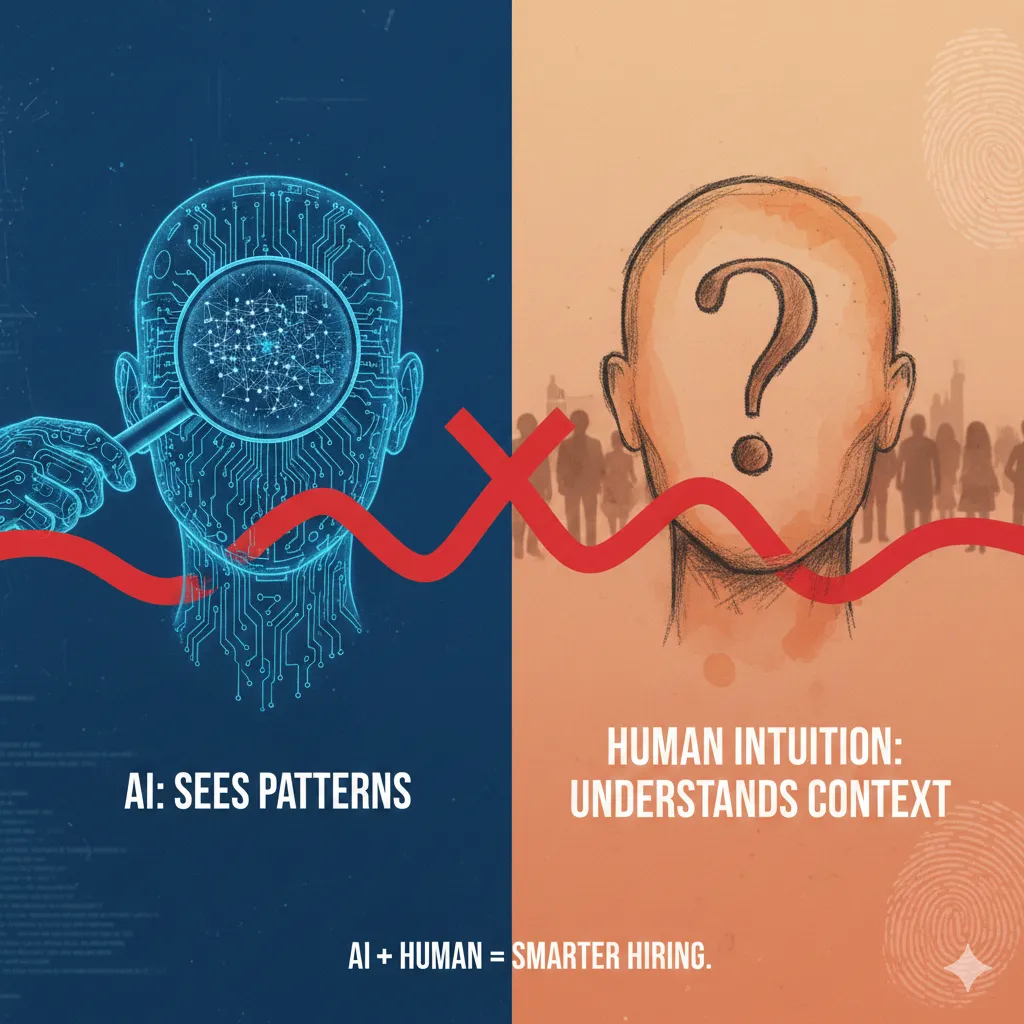
The Complete Guide to AI in Hiring: What It Sees, Where It Fails, and How to Use It Right
You're probably a terrible judge of talent.
I know that sounds harsh. You've hired dozens, maybe hundreds of people. You've developed your instincts. You know what to look for in an interview.
But here's the uncomfortable truth: your brain is working against you—and AI might be the solution you need. If you use it correctly.
Part 1: What AI Sees That You're Programmed to Miss
Why Our Pattern Recognition Fails
When you interview a candidate, you're trying to process an overwhelming amount of information: their resume, their answers, their body language, their tone, how they compare to the last three people you interviewed, and how they might fit with your team.
Your brain does what brains do—it takes shortcuts. It looks for familiar patterns, makes quick judgements, and fills in gaps with assumptions.
And we're particularly vulnerable to specific blind spots:
Inconsistency: Interview number eight on a Friday afternoon doesn't get the same quality of attention as interview number two on Tuesday morning.
Base Rate Neglect: If 70% of successful salespeople at your company are extraverted, we assume extraversion is essential. We miss that 65% of unsuccessful salespeople are also extraverted—so it's not actually that predictive.
Availability Bias: That amazing hire from last year who "just had something special"? We start looking for those same qualities, even if they're not what actually made them successful.
AI doesn't have these problems. Or more accurately, it has completely different problems.
The Micro-Patterns We Miss
Behavioural Language Patterns
AI can analyse subtle language patterns in application responses or interview transcripts that reveal cognitive styles and personality traits. It might notice that candidates who use more concrete examples rather than abstract language perform better in operational roles, whilst the opposite is true for strategic positions.
It can detect when candidates consistently take credit versus share credit, when they focus on challenges versus solutions, or when their energy level shifts between different topic areas—patterns that might span a 45-minute interview and get lost in our memory of the "overall impression."
AI processes hundreds of data points across thousands of hires to detect these nuanced relationships that human observation simply cannot track.
The Key Insight
AI isn't better because it's smarter. It's better because it's systematic, tireless, and immune to the cognitive shortcuts that lead us astray.
It finds patterns in the noise that we can't see—not because we're not intelligent enough, but because our brains weren't designed to process information this way.
The question isn't whether AI can spot patterns we miss. It absolutely can.
But that raises an important question: should we just let AI make all our hiring decisions?
Part 2: Where AI Falls Short (And Why You Still Need Human Judgement)
The evidence is compelling: AI can process more data, remain consistent across hundreds of interviews, and identify subtle correlations that humans miss.
So why not let AI make all our hiring decisions?
Because AI has some serious limitations—and understanding them is crucial if you want to use it effectively.
The Context Problem
AI Doesn't Understand Your Unique Situation
AI can tell you that a candidate scores highly on conscientiousness and analytical thinking. What it can't tell you is whether those traits will work in your specific environment.
Maybe your team is going through rapid change and needs someone adaptable rather than process-driven. Maybe your company culture values speed over perfection. Maybe this role reports to a manager who needs someone who can push back, not just execute.
These contextual nuances—the unwritten rules, the team dynamics, the strategic direction that's still being debated—are invisible to AI. They require human understanding of the situation on the ground.
The "Right Person, Wrong Time" Challenge
A candidate might be brilliant but not ready for this particular challenge right now. Or they might be overqualified in ways that will lead to frustration six months in. AI struggles with these temporal judgements because they require understanding not just the person and the role, but the trajectory of both.
The Novelty Problem
AI Learns from the Past
This is AI's fundamental limitation: it can only recognise patterns it has seen before. It learns what "good" looks like by analysing your previous successful hires.
But what if your previous hiring patterns are exactly what you need to break?
What if you need to:
Hire your first remote worker in a traditionally office-based role
Bring in someone from a completely different industry to challenge assumptions
Build a new capability that doesn't exist in your organisation yet
Diversify a homogeneous team
AI trained on your historical data will, by definition, favour candidates who look like your past hires. It will score highest the people who fit existing patterns—even when breaking those patterns is precisely what you need.
The Human Elements AI Can't Measure
Chemistry and Team Dynamics
Can this person collaborate effectively with your existing team? Will they clash with your head of operations? Do they have the emotional intelligence to navigate your organisation's politics?
These questions require observation of subtle interpersonal dynamics. AI can analyse language patterns in interviews, but it can't sit in on a team meeting and feel the energy shift when someone speaks, or notice who defers to whom.
Motivation and Cultural Alignment
Why does this candidate want this job at this company? Are they running from something or running towards something? Do they understand what you're really asking them to do?
AI can flag inconsistencies in someone's career trajectory, but it can't probe the deeper "why" behind their choices. It can't gauge whether their eyes light up when you describe the mission or whether they're just interviewing well.
Growth Potential and Coachability
Some candidates are rough around the edges but have enormous potential. They're missing skills but have the drive and learning ability to acquire them quickly. They might not have the exact experience, but they have something harder to teach: curiosity, resilience, self-awareness.
These qualities are notoriously difficult to measure—even for humans. For AI, they're nearly impossible to quantify from standard assessment data.
The Right Balance
None of this means AI isn't valuable in hiring. It absolutely is.
But AI works best as a decision support tool, not a decision maker. It should:
Screen large volumes of applicants to identify promising candidates
Flag patterns and insights that humans might miss
Provide consistent, objective data points to inform discussions
Challenge our assumptions and biases
Humans should still:
Make final hiring decisions
Assess cultural fit and team dynamics
Evaluate context-specific factors
Override AI when the situation demands it
Ensure decisions align with strategic needs
The goal isn't to replace human judgement with AI. It's to augment human judgement with AI—to combine the pattern recognition capabilities of machines with the contextual understanding, intuition, and strategic thinking of humans.
That's where the real power lies.
Part 3: The Winning Formula - Combining Science, Context, and AI
So how do we actually use AI effectively in hiring?
The answer is building a system that combines proven scientific tools with AI's pattern recognition capabilities—all grounded in deep contextual understanding of what you actually need.
The Three Essential Elements
Effective AI-assisted hiring rests on three foundations:
Science-based assessment tools (personality profiling, cognitive assessments, structured interviews)
Rich contextual information (detailed role requirements, team dynamics, company culture)
AI pattern recognition (analysing how these factors combine to predict success)
Remove any one, and the whole system fails.
Why Personality Profiling Matters
Decades of research have established that certain personality traits predict job performance. The Big Five dimensions—openness, conscientiousness, extraversion, agreeableness, and emotional stability—have robust correlations with workplace outcomes.
But these traits don't work in isolation, and their importance varies dramatically by role and context.
A highly conscientious person might excel in an accounting role but struggle in a fast-moving startup where "good enough and shipped" beats "perfect but delayed." High extraversion might be essential for business development but exhausting in a role requiring deep, solitary focus.
This is where AI becomes powerful. Instead of applying generic rules, AI can analyse your specific organisation's data to understand which personality trait combinations predict success in your roles, within your culture.
AI doesn't replace the science—it applies the science to your specific context.
Context Is Everything
The Biggest Mistake in AI-Assisted Hiring
Most AI hiring tools try to be one-size-fits-all. They apply generic models to predict success at your company.
But your "successful salesperson" might look nothing like one at your competitor. Your definition of "leadership" might emphasise collaboration whilst another organisation rewards top-down decision-making.
If you feed AI generic role descriptions and vague requirements, you'll get generic results.
What AI Actually Needs to Know
For AI to provide genuinely useful insights, it needs rich contextual information:
About the Role:
What does success look like in the first 90 days? The first year?
What's the balance between independent work and collaboration?
What are the common failure modes for this position?
About the Team:
What personalities and working styles already exist?
What gaps need to be filled?
What's the management style of the direct supervisor?
About the Company:
What stage is the organisation at (startup, scaling, mature)?
What's genuinely valued versus what's written on the wall?
What causes people to leave this role?
This isn't busywork. This is what transforms AI from a generic screening tool into a genuinely predictive system.
Job Benchmarking: Creating Your Ideal Candidate Profile
Most job descriptions are terrible at predicting who will actually succeed. They list qualifications, not competencies. They describe tasks, not what makes someone excellent at those tasks.
Job benchmarking is the process of thoroughly analysing both the hard and soft requirements of a role to create an ideal candidate profile.
Hard Requirements:
Technical skills and qualifications
Experience levels and industry knowledge
Specific competencies (e.g., financial modelling, project management)
Educational background where genuinely necessary
Soft Requirements:
Personality traits that enable success in this specific role
Behavioural competencies (e.g., resilience, attention to detail, strategic thinking)
Communication and interpersonal styles that fit the team and culture
Motivations and values that align with the work and organisation
The result is an ideal candidate profile—a comprehensive picture of what the right person for this role actually looks like.
This profile becomes your benchmark: a standard against which every candidate can be objectively compared.
Where AI Becomes Powerful
Once you've created this ideal candidate profile, AI can:
Compare candidate assessments against the benchmark
Weight different factors based on their importance to success
Identify candidates who match the profile even if they lack traditional qualifications
Flag potential mismatches before you invest interview time
Provide objective scores that enable fair comparison across all applicants
The AI isn't making arbitrary judgements. It's measuring how closely each candidate matches your carefully defined ideal.
Bringing It All Together
Step 1: Define Your Context Create a detailed job benchmark that defines the ideal candidate profile for this specific role in your organisation.
Step 2: Use Science-Based Tools Assess candidates using validated personality profiles, cognitive assessments, and structured interviews.
Step 3: Let AI Find the Patterns Feed the assessment data and contextual information into AI systems that identify which combinations predict success in your situation.
Step 4: Apply Human Judgement Use AI insights to inform your decision and challenge assumptions—but make the final call based on the complete picture.
The Compounding Effect
This approach gets better over time. As you hire people and track their performance, the AI learns what actually predicts success in your organisation.
But this only works if you provide:
Valid, science-based assessment data
Rich contextual information
Honest performance feedback
The Bottom Line
AI alone can't hire well. Science-based tools alone can't hire well. Even deep contextual knowledge alone can't hire well.
But combine all three—validated assessments, rich contextual understanding, and AI's pattern recognition—and you've got something genuinely powerful.
A hiring system that's both scientifically rigorous and contextually intelligent.
And that's when you stop making expensive hiring mistakes and start building teams that actually deliver.
About the Author: I have 25+ years in tech: software architecture, cloud infrastructure, SaaS product development, and R&D team leadership. Expertise in full-stack development, mobile technology, UX design, and online marketing.
My current focus is GrowMyTeam.ai which is an AI-first system aimed at making recruitment faster, better and cheaper by using all of the latest AI advancements!
Want to learn more? Click here to book a time for a chat about GrowMyTeam.ai
